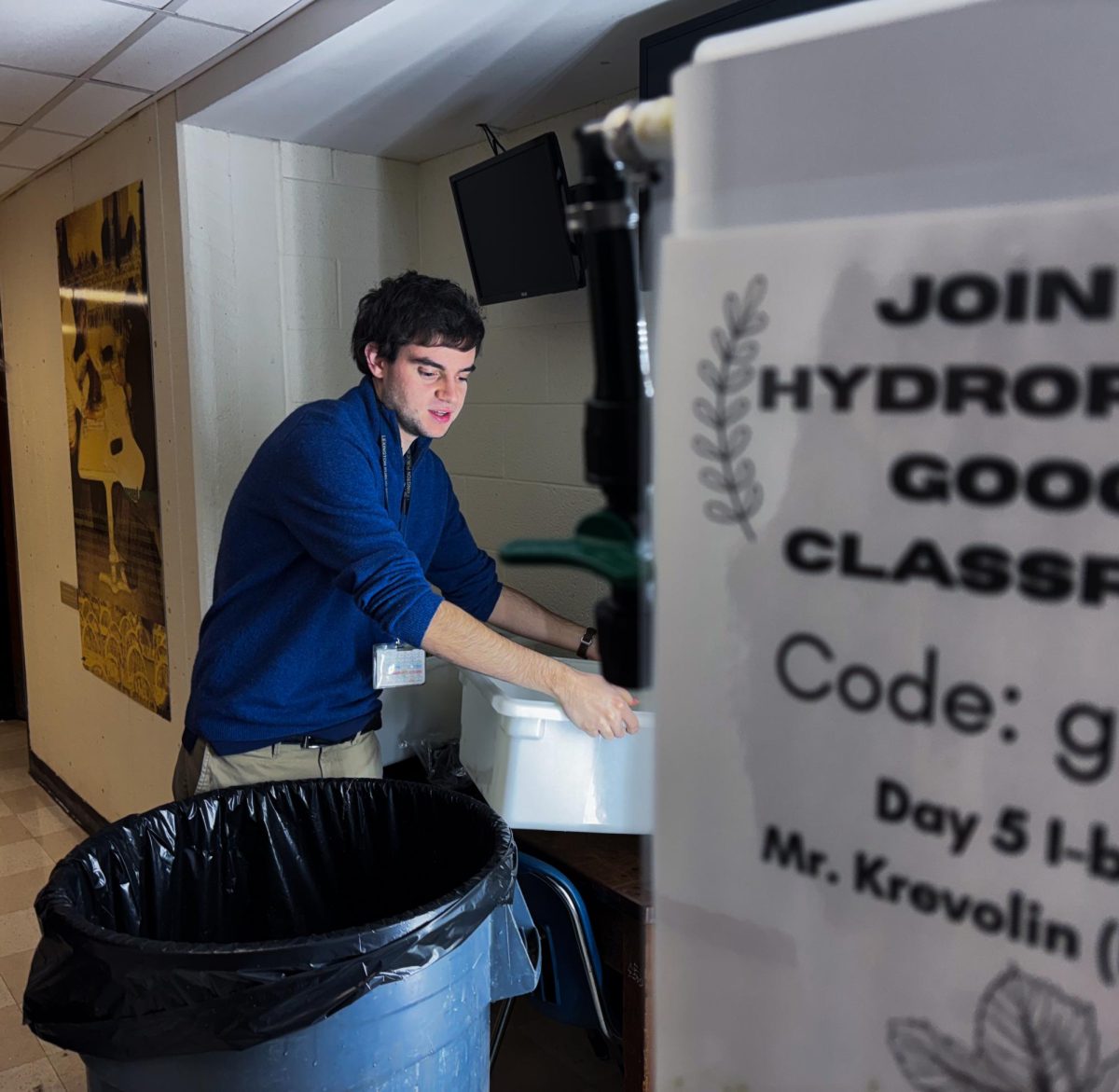
The Lexington High School Hydroponics Club, advised by LHS science teacher Nathan Krevolin, builds and maintains various hydroponics setups around the school. The resulting plants are harvested for use in school cafeterias.
“My main goal is to help teach students about the benefits of connecting these two realms of agriculture and hydroponics,” Gwenyth Dahl, a senior at LHS and a leader of the club, said.
Rather than using soil, the hydroponics setups, which are split in half to allow access to the plants, circulate water and nutrients throughout a series of vertical panels. These vital elements are added and stored in a reservoir below, and a pump takes them up before they drip back down on the leaves.
“It’s an exercise in applied biology and sustainable fun practices,” Krevolin said.
The hydroponic setups were inspired by Krevolin’s time at UMass Amherst, where he helped produce lettuce through hydroponic setups.
“I thought it was a fantastic way to learn about science and plant biology in a hands-on way, in a problem-solving way, rather than just in the classroom,” Krevolin said.
Whitson’s Food Service, the company that runs the food services for the district, provided thousands of dollars for the purchase of hydroponics setups. However, being a newly formed group, the hydroponics club initially faced some difficulties. Aside from the logistics of forming a new club and recruiting members, it took effort to understand and build the hydroponic systems. Additionally, members needed to consistently maintain nutrient levels within the systems for the plants to thrive.
“We’re at a point now where we have gotten the farm off the ground, and we’re starting to see some really nice harvesting yields. But we overcame some early issues just by trial and error and working things out,” Krevolin said.
So far, the club has largely been working with lettuce and basil plants. Recently, they’ve received a shipment of seeds for various herbs, lettuce varieties, and edible flowers. They are also considering growing different fruits and vegetables, like tomatoes and peppers, in the future.
There are also immediate implementations of the produce into class activities: one AP Biology class used spinach from the hydroponic setups in their labs.
More broadly, the hydroponics club provides a way for students to explore the rapidly growing field of sustainable agriculture. With a changing climate and ever-increasing population, a significant issue in the 21st century is finding new methods of food production. The versatility and accessibility of hydroponic systems make them an effective solution to many of these problems.
“I think getting these younger generations, mine and future ones, continually invested in these sorts of projects and environmental food in general is really important,” Dahl said.