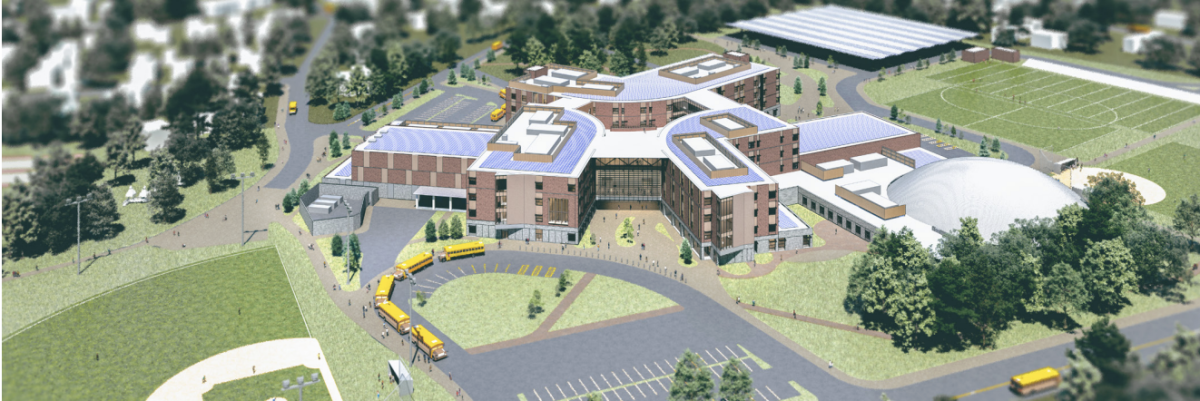
The Lexington High School Building Committee recently approved the Bloom design for a new high school that emphasizes sustainability and environmental responsibility.
“Right from the beginning, we knew that this was going to be a school with no fossil fuels,” Kathleen Lenihan, the School Building Committee chair, said.
One key step towards sustainability is installing solar panels on top of the school and on parking lot canopies. These panels will generate enough solar power to have a net-zero energy consumption.
“Traditionally, we’ve had to either use fossil fuels, like gas or oil, to [create energy], or we’ve had to take power from the grid, which is often produced through sources that aren’t clean… The energy we’re going to use to heat and cool the building is now largely going to come from our own sources,” Daniel Voss, a member of the Sustainable Lexington Committee, said.
The new building will utilize solar-powered ground- and air-source heat pumps, replacing the traditional burners and compressors used for air conditioning. Through these systematic methods, the school’s air quality will improve—a top priority for the committee.
“We need to have that healthy air quality that is important for your health and cognitive abilities at school … As the climate’s changing, it used to be thought that air conditioning was a luxury in the schools, but it’s not a luxury anymore. It’s important for your health and your ability to think, as well as the health and well-being of all the educators,” Lenihan said.
This shift will not be just for heating and cooling, but also for other essential applications around the school.
“There is no gas cooking, and even for chem labs, instead of having Bunsen burners there, there are electric equivalents, or there will be localized canisters,” Joe Pato, a member of the Select Board, said.
The committee is also addressing potential disruptions to students during construction, which is scheduled to begin in 2027 if the town’s vote passes.
“[The school administration] is considering putting on some screening material to avoid distractions … They’re also considering putting in some air handling units for parts of the math building and parts of the science building, so that instead of having to open windows to get air flow, there would be conditioned air in those rooms with temporary air conditioning units,” Pato said.
Although construction will inevitably pose some temporary disruption, the sustainability of the new building will ensure its longevity for future generations of LHS students.
“We’re aware that we’re building a school that should last until the 22nd century … We don’t know what education is going to look like in 50 years, but we know that it’s going to happen, and we want those future Lexington students to be in as safe and as sustainable an environment as possible,” Lenihan said.