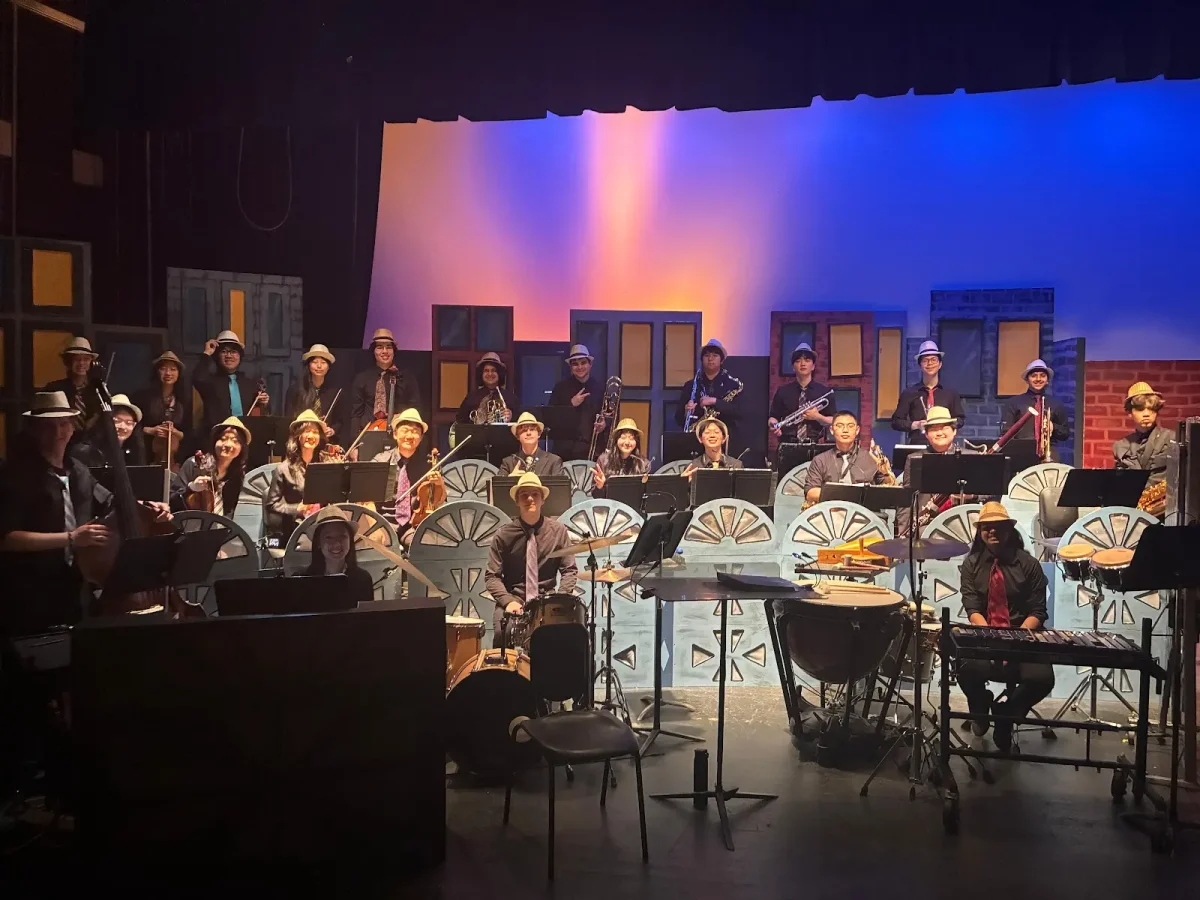
From Nov. 19 to 21, Lexington High School’s fall production of The Alibis was in full show. The play followed a detective’s investigation to discover the culprit of a murder, with each scene, written by a different playwright, centered around a certain suspect and their wildly absurd alibis.
“[The Alibis] is really unique. It’s written by not one, but eight different playwrights, and it takes a spin on murder mystery, or a whodunnit type of play,” Aman Verma, a senior and lead actor in the play, said. Verma played Warwick, a butler.
While not acting, sophomore Rewa Deshpande served as stage manager for the play: she highlighted the various facets of organization that go into a successful production.
“We always say that ‘without actors, you wouldn’t have anything to see, but without lights, you wouldn’t see the actors at all, because they’d be in the dark.’ With that in mind, every piece: tech, directors, actors, costuming, everything had to work together,” Deshpande said.
The entire crew devoted long hours to rehearsals and preparation, especially during the days leading up to opening night. This led to difficulties for students as they balanced homework and the after-school commitment required by the production.
“I was called for almost every single [rehearsal] as we got closer to the production, but I wasn’t used up for the whole time … I try to be productive, balancing my school work with all these productions, all these rehearsals, but in the end it was a little harder to balance them, especially with senior year,” Verma explained.
Moreover, sophomore Apoline Grenez, a costume designer, discussed the difficulty of evenly dividing work amongst crew members.
“I think the most challenging part is working enough, but not too much … It’s working with others to make sure that everything [gets] done, but not that someone is taking too much work home and doing too much,” Grenez said.
Thanks to the rigorous preparation before the official production, the opening night of The Alibis went smoothly. Despite a few minor issues, the show continued without disruption.
“The beauty and the problem with live theater is that we have to learn to problem solve and just go with it. And so we did have some difficulties Friday and Saturday night, but they were still great shows,” Deshpande said.
The “second night slump”, when productions drop in quality due to actors fatiguing following the first night, is a common phenomenon in theater. However, this was not the case for the production.
“For me, I felt more nervous because I knew that there were more people coming on Friday than Thursday … But for this show, I feel like the cast as a whole got better every single day,” Verma remarked.
All the effort and preparation were reflected not only in the show’s success but also in the bonding between the entire community.