Lexington High School recently approved a new science curriculum that makes Advanced Placement (AP) Biology and Chemistry second-year courses, reduces the number of times AP courses meet per six-day cycle, and separates AP Physics C into two classes: Mechanics, and Electricity and Magnetism. The changes, which will be implemented next school year, were made to ensure equity in instructional hours for teachers, as well as to align LHS’s AP courses with guidelines designated by CollegeBoard. More information on the curriculum is outlined in this memo by Principal Andrew Baker, as well as in this slideshow.
To gauge student opinions on the curriculum changes, The Musket sent out a survey to all LHS students on Thursday, Jan. 29. 169 students responded, with the largest percentage (43%) of them being from freshmen, followed by sophomores (27%), juniors (17%), and finally seniors (13%). A majority of respondents strongly disagreed with the new structure of the science curriculum.
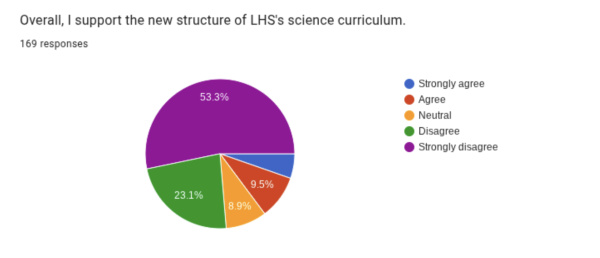
Many students’ frustrations stemmed from their inability to take AP Biology or Chemistry in tenth grade, having to first take a prerequisite College Preparatory (CP) or honors class. This aspect of the new curriculum was the least popular among students who filled out The Musket’s survey, with 61.5% of respondents strongly disagreeing with the change.
Students expressed concerns that making AP Biology and Chemistry second-year courses would increase the workload and stress for those who want to take all possible science APs. Such students feel pressured to give up free blocks and elective courses in order to have space for AP science and its prerequisites.
“Extending courses over two years rather than one makes things more difficult for students and overall less doable,” Ayla Das, a freshman, told The Musket. “It discourages the pursuit of academic enrichment and builds barriers between what’s feasible and what is desired.”
Especially for those who enjoy science or hope to pursue a scientific field in the future, a first-year Biology or Chemistry course may lack the rigor a student desires. It may also overlap in content with its respective AP class.
“The AP classes offer students the opportunity to dive deep into something they want to learn about—something that I have really benefited from,” Trevor Stevens, a junior, said. “I think the idea of taking multiple science classes every year is not going to be interesting to most people. And it’s repetitive, even if you are interested.” An anonymous survey respondent described first-year Biology and Chemistry as “a vast investment in time and not worth any marginal gain in ability.”
Logistically speaking, a student who wishes to take all four science APs in the course of high school will now take 28 science credits, rather than 23 credits under the old curriculum. Some felt that this increase took away opportunities that set LHS apart from other schools.
“Doing this doesn’t just weaken LHS’s curriculum — it undercuts the very identity of the school. […] The AP program is one of the few areas where LHS consistently excels, with a five rate that outperforms almost every other district. Instead of building on that success, this change punishes the students who are ready for advanced work,” an anonymous student wrote.
Because APs are designated as college-level courses, some students are also concerned that their college readiness will be jeopardized because they have less access to advanced classes.
“It takes away that speed element, which is really important in college. You have to be able to learn under pressure and going high speed,” Jai Bhalla, a senior, said.
On the other hand, supporters of the new curriculum have argued that it offers more choice for those not interested in taking all of Biology, Chemistry, and Physics.
“As a Freshman, I didn’t plan myself to take [both AP Chemistry and AP Biology] in the first place, and now we have the option to do Chemistry in tenth grade, [which] is actually better for me,” Forest Lin, a freshman, told The Musket.
Students also recognized that the large jump from freshman Earth Science to AP Biology in tenth grade could be overwhelming, especially given the general intensity of AP science courses at LHS.
“It’s part of the duty of the school to prevent us, or at least try to discourage us from making decisions that we aren’t necessarily prepared for. And I think that the step up to AP Biology is one of those where sometimes we aren’t able to fully understand how difficult of a course it is,” Darius Jin, a senior, said.
Survey respondents noted that the new curriculum could encourage underclassmen to spend more time pursuing non-academic interests. Jin agrees: “LHS is somewhat known for being an extremely difficult and rigorous school, and sometimes that doesn’t translate to the students’ overall wellbeing. […] It’s like, is this the best choice for me to retain information, to continue enjoying learning and […] trying new things without all that pressure?”
Regarding the reduction in frequency that AP science classes meet per six-day cycle (from six days to four), students had mixed opinions. 34.3% of survey respondents strongly disagreed with the change, while 14.2% strongly agreed. Though some students believe the six-day format is necessary to cover all the material in an AP course, others believe that having science classes meet less often is more manageable.
“I am a three-sport athlete, so a lot of times I have to leave early, and oftentimes it’s really hard to make up science classes because they meet every day. […] Right now, I have Physics last block four out of six days of the cycle. And in the last two weeks, we’ve had three hockey things where we’ve had to miss last block,” Margaret Urdan, a senior, told The Musket.
Urdan felt that having homework for a science class every night of the week could be draining. “It also indirectly makes LHS a STEM school, because the sciences meet so many more times than the humanities,” she added.
Other students thought that the change in class frequency would align science AP courses with other APs at LHS.
“I think [it’s] about standardizing what an AP is at the school. It makes the AP course name itself bear the same meaning, so that students can at least know what they’re getting into,” Jin said.
36.7% of survey respondents also strongly disagreed with the separation of AP Physics C into two courses. Both Mechanics and Electricity and Magnetism will be offered as first-year courses available to juniors and seniors who meet the calculus pre/co-requisite.
The several juniors who disagreed with the split pointed towards the illogical nature of taking Electricity and Magnetism without substantial math and physics knowledge.
“I’ve heard that for the E&M section, you need to already know some calculus so it doesn’t make sense to start at the beginning of the year,” Stevens said.
Students also pointed out that physics altogether is more comprehensible once one has taken mechanics, which is currently taught in the first semester of AP Physics C.
“Offering just E&M (Electricity and Magnetism) is kind of silly, because at least to me, E&M makes way, way more sense if you take mechanics first. If you’re going to offer them, you can either offer them at the same time, or you have to just take mechanics,” Atticus Oliver, a junior, said.
Overall, most students saw no reason to change the current AP science curriculum. Both supporters and dissenters of the new curriculum did suggest removing Earth Science as a requirement for freshmen, so that students could have more flexibility in their academic pursuits.
“The school should allow you to really customize the order that you take classes in. The only real requirement, as far as I know, is that you have to take one of Biology or Physics, so that you can take the MCAS in tenth grade. But allowing kids to take the classes in a different order could be interesting for kids [to] prioritize what they want to do,” Oliver said.
Oliver also proposed allowing students to accelerate past first-year Biology or Chemistry via a skip test, similar to the way that the math curriculum at LHS is structured. The school opposes students skipping a science course due to the “deeply developed laboratory techniques, inquiry skills, and teamwork” that administrators believe are a necessary component of introductory Biology and Chemistry.
Ultimately, students told The Musket that they hoped for better communication between the school and its students. They felt that they were not provided a proper explanation for curriculum changes that they saw as disruptive and teacher-centric.
“I think that either it’s poor communication, or there’s a disconnect between the administration and the students that really needs to be addressed if [we want there] to be a good relationship between the two populations going forward,” Bhalla said.
Other students acknowledged that while teacher parity is extremely important, changes to a curriculum should also be run by students before being implemented.
“In the future, when the school plans to change our curriculum, students should have a chance to vote or at least review the changes,” Lin said.