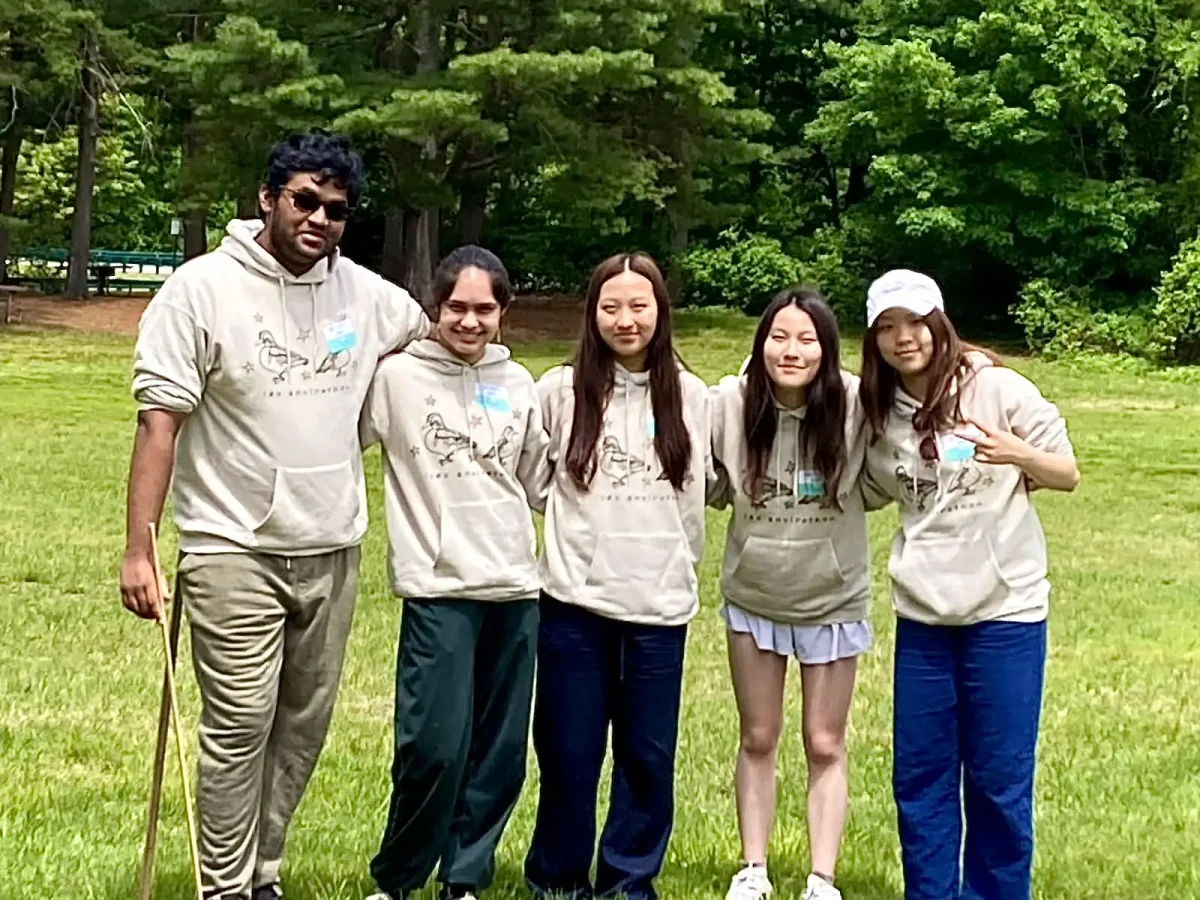
On Feb. 12, Lexington High School hosted its annual Science and Engineering Fair in Commons II. The fair was the culmination of months of independent research, where students pursued their interest in various sciences and then presented their projects to judges, peers, and parents.
Topics ranged from mathematics to engineering to microbiology, exposing participants and observers to a variety of novel ideas.
“It was really interesting to see what other people did, because they were all really new topics and different topics that I haven’t thought about. They’re all interesting in their own ways,” Daniel Lim, a sophomore, said.
Lim’s project involved using artificial intelligence to detect strabismus, an eye condition that can lead to vision loss.
“I had a friend back in Korea [who] found out he had strabismus, and it got worse and worse. I felt bad, and I just thought it would be good if I could make something that could help people like him,” Lim explained.
The project provided Lim the opportunity to explore the potential of technologies such as AI to improve health equity.
“We see AI all over the place these days, and I think it is really important to expand medical care or access to healthcare for people who have limited access to them through AI,” Lim said.
Junior Laiba Khan’s project similarly employed a machine learning approach for early diagnosis of Parkinson’s disease, a severe neurodegenerative disease often characterized by a loss of motor control. The project also incorporated Riemannian geometry, a branch of differential geometry in mathematics.
“Neurodegeneration runs a lot in my family, and a key thing is recognizing early biomarkers for it, so that we can identify [it] fast and get treatment for it,” Khan said.
Students often spend months in preparation for the science fair. Reflecting on her independent research process, Khan emphasized the importance of continuous progress.
“It was just dedicating a little bit of time to yourself each day to making sure that you have what you need for the project done, so that you didn’t have to rush last minute,” Khan said.
On the day of the science fair, students presented more than 30 projects in total. Both Lim and Khan echoed the value of interacting with other participants.
“I think [meeting new people and seeing their projects] was really cool, just learning about what people are interested in and seeing how they approached it,” Khan said.
Both Lim and Khan encouraged students who are interested to consider participating in the science fair.
“As long as you find something you’re passionate in, and if you work towards it, I think anyone should participate in the science fair,” Khan said.