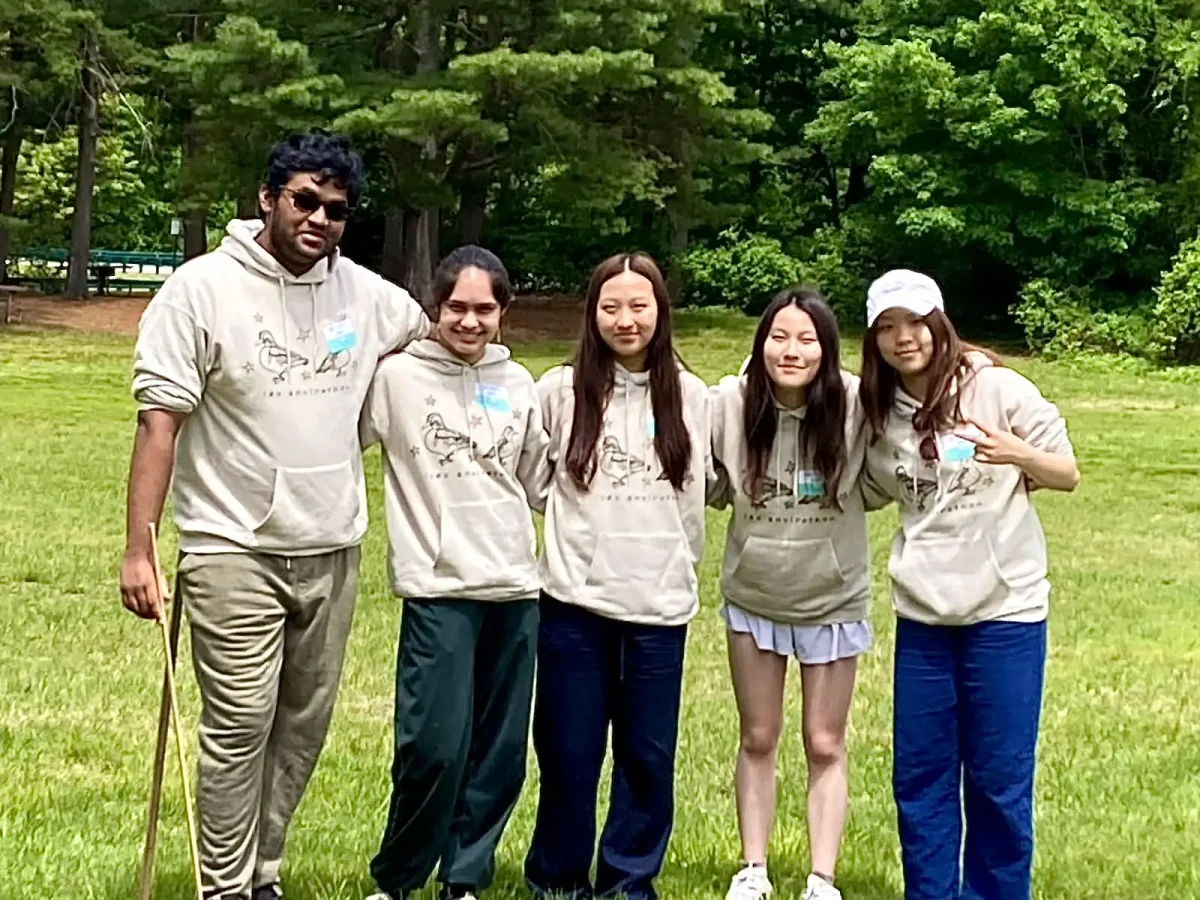
This past May, over 1,700 high school STEM students from all over the world met up in Phoenix, Arizona, to compete for the International Science and Engineering Fair (ISEF). Among these contestants were Lexington High School students Jerry Xu, a senior, and Laiba Khan, a junior.
ISEF is a highly prestigious pre-college science and engineering competition run by the biotech company Regeneron and designed to present young researchers in STEM with the opportunity to win tens of thousands of dollars in cash and scholarships to top-quality colleges.
“[ISEF] encompasses research over a wide range of categories in a place where you can collaborate with other researchers. Ultimately, it’s just a fun place where you can learn more and compete for a lot of money,” Khan said.
The fair is not a competition that a student can simply register for. To qualify for ISEF, Khan and Xu had to receive top awards in regional and state science fairs beforehand.
In Khan’s case, she was recognized for ISEF through her screening device for neurodegenerative disorders, which utilized Grassmannian geometry to analyze gaits and speech patterns.
“There was low-cost hardware involved. What that does is create a multi-model system in which we can assess neurodegenerative disorders – such as Parkinson’s – more accurately and more cheaply,” said Khan.
Xu qualified for ISEF through his development of an AI model that could rapidly compare the structures of proteins and nucleic acids. With this model, Xu won fifth place at Regeneron’s extremely prestigious Science Talent Search competition.
Nationally, fewer than one percent of students who participate in local and regional science fairs advance to ISEF.
“The thing that keeps me going, honestly, is just a passion for science,” Khan said. “A passion to make change from what I know I can do, and to honestly just learn a lot of cool things along the way.”
For Khan, qualifying for ISEF represents more than just an academic accomplishment. It is also a reflection of her continued interest in using mathematics and technology to address real-world medical challenges. Alongside Xu’s achievements in artificial intelligence research, the success of both students highlights the growing presence of advanced STEM research at LHS.
As students like Khan and Xu continue to pursue innovative scientific work, they serve as examples of how curiosity, dedication, and passion for discovery can lead to opportunities on an international stage.
“I feel super excited and proud that I’m able to get to a point like this,” Khan said. “It motivates me to do more research and science in the future.”