
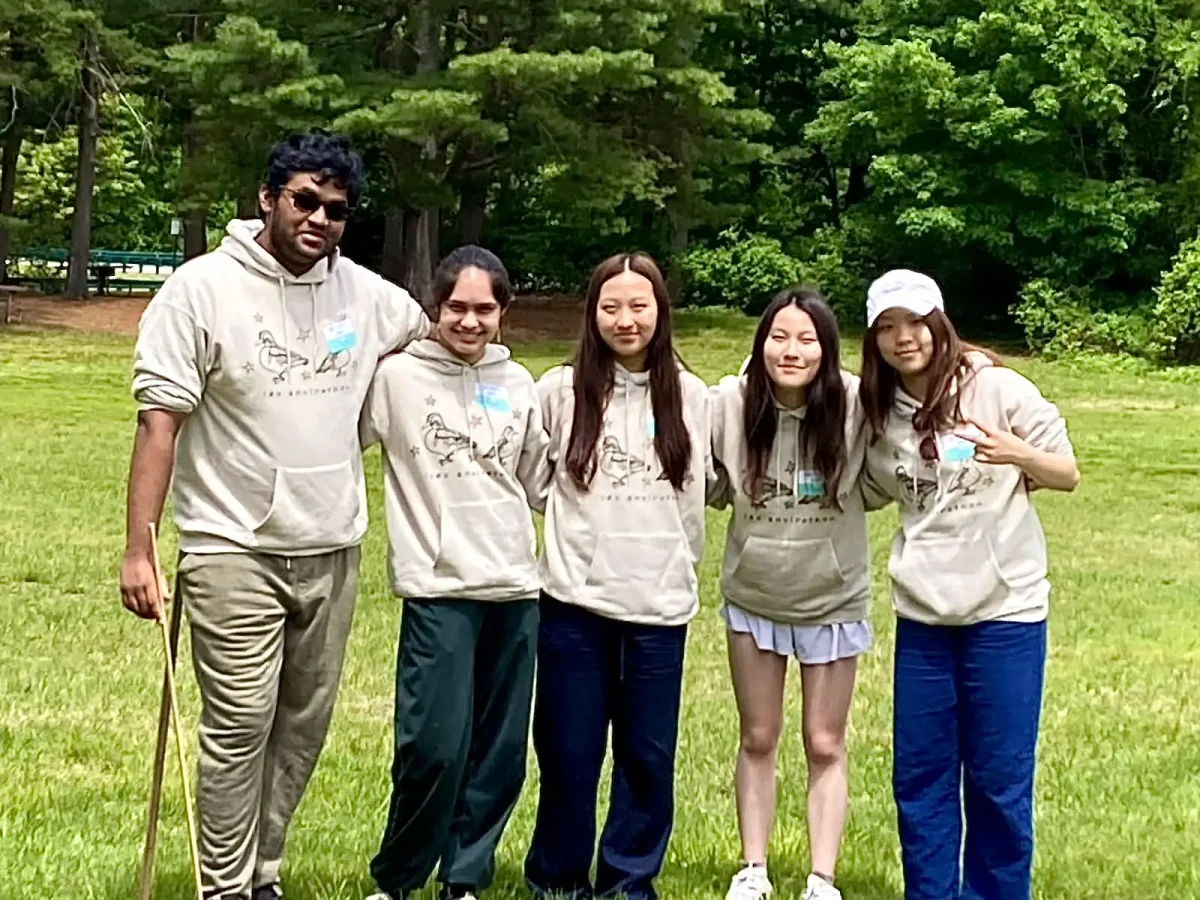
Since the start of the school year, the Lexington High School Envirothon Club has been preparing for the Massachusetts Envirothon, a statewide environmental science competition held this past May.
On May 21, the club traveled to Hopkinton State Park, where teams rotated through a series of testing stations, known as substations, covering current environmental issues. At each station, students completed hands-on challenges and answered questions that assessed their environmental knowledge and problem-solving skills.
“Throughout the year, we’ve had about one-and-a-half-hour meetings on Thursday where we usually learn stuff, and recently, we’ve been having more meetings on other days to work on our poster and our scripts,” Fiona Wu, a sophomore and Envirothon member, said.
At each meeting, the Lex Envirothon studies four main subtopics: aquatics, or marine science and water quality; soils, which require knowledge of soil type and composition; forestry, which involves learning about and identifying local plants; and wildlife. Members in Envirothon learn not only broad topics, but also those on a personal level, too.
“In Envirothon, a lot of the info is a lot more like the local level. So there’s a lot more depth, and it’s really interesting to learn about how people in your community face these issues and how to resolve them,” Wu said.
While Envirothon is similar to other science competitions in many ways, preparation for the competition varies, with Envirothon veering away from the more traditional science competitions to engage with a broader community through volunteering, scientific skills, and research.
“Envirothon is definitely more hands-on, because with things like Science Olympiad and Science Bowl, you’re in a very static environment—you’re doing written tests, basically standardized testing,” Taya Slobodchikov, a sophomore and Envirothon member, said. “Science Bowl is a little more conversation-based with your team, but in Envirothon, you really get to go outside. You get to apply your knowledge to the real world, and you see how it affects what you do in conservation and the environment all around you.”
There are many other unique aspects of the club. For example, the competition takes place outdoors in an environment that contestants are tasked to interact with, as well as create and present a proposal that addresses an environmental prompt for each year. Rather than only testing on paper, data collection and critical thinking regarding the environment are major aspects.
“At the competition, we have one part, which is going to be the four subspaces, where you take a written test on them. Then another part will be a presentation that we’ve been preparing over the whole year, and we make a poster board, and we memorize the script,” Helen Miao, a sophomore and Envirothon member, said.
Who is going to compete, and in what substation, is decided over the course of the year. Captains help teach the rest of the club about the topics, and individuals engage in research and review that culminates in a series of tryouts that determine the teams for a given competition.
“Throughout the year, there are several tryouts, and the captains sum up the tryout scores and decide who’s going to be on which team. And then in May, we have a competition, and there are two teams, A and B, that both go,” Wu said.
For this year, the pressure is on. Lexington has an impressive track record, with multiple national wins in recent years, including in 2025, 2023, and 2022, with consistent top ten rankings. This year, the Envirothon club is preparing to advance through states and compete once again at the national level. As for another national title, the club has been preparing all year.
“We’ve got hope for next year as well,” Miao said.