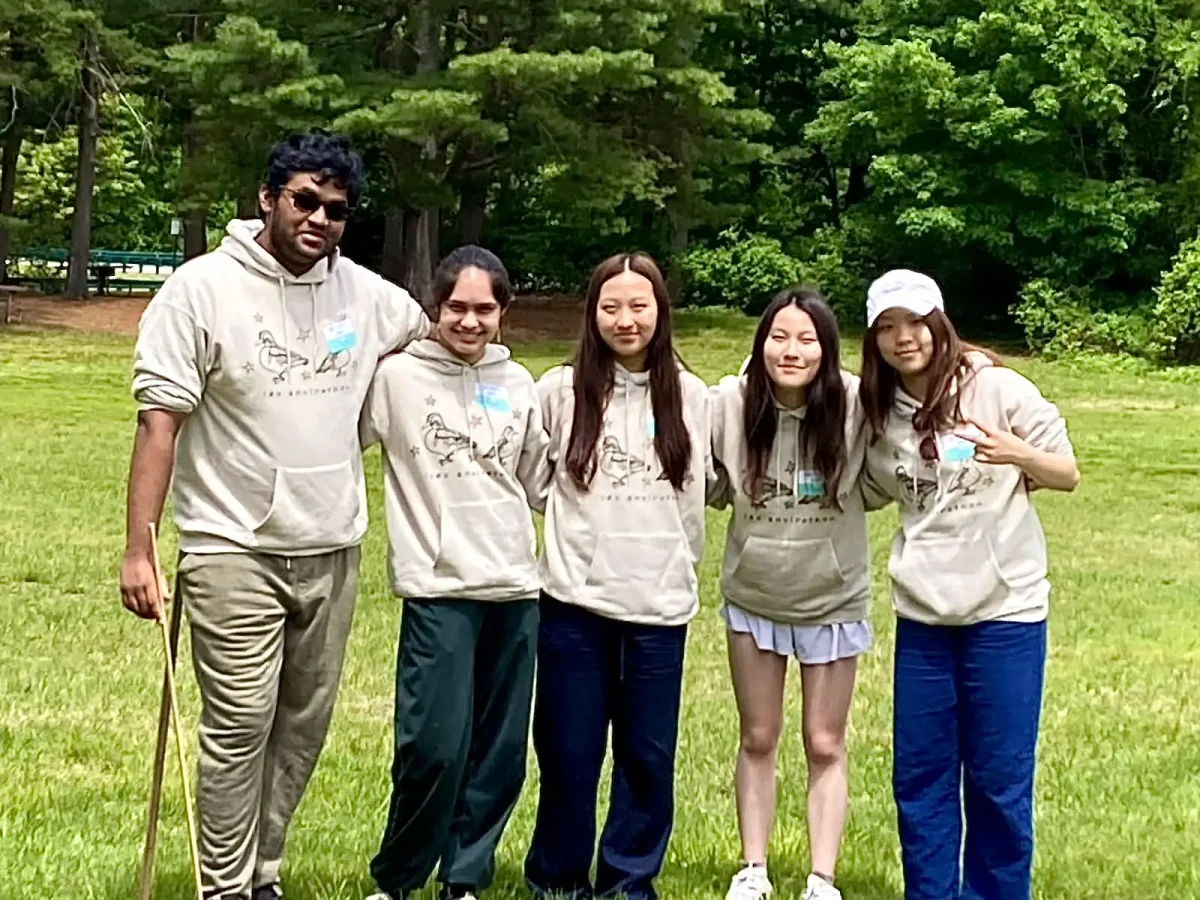
Each year, around 100 students try out for Lexington High School’s Science Olympiad (SciOly) team. Science Olympiad is a team-based competition featuring various sciences, including biology, earth science, physics, chemistry, and engineering. Tryouts, which began in Nov., narrowed the team down to 45 members. These students are then split into three teams of 15. Each member generally competes in three to four events on average, and the team travels around the country to compete at invitationals held on college campuses.
“There are 23 events every year, each with a slightly niche focus, and this can range from epidemiology to building a hovercraft,” Isabella Wang, a junior and SciOly co-captain, said.
In previous years, Science Olympiad has held one round of tryouts to make cuts and determine who will be on the A, B, and C teams, the three LHS Science Olympiad teams that are arranged based on students’ abilities. For tryouts, students choose a few events to study for, which they are then tested on. Additionally, students can also choose to do build tryouts, where students create a device based on a specific set of criteria and test it. In recent years, the captains implemented a fluid system for team arrangements, where students who out-competed members of higher classed teams at invitationals could be moved up.
This school year, the Science Olympiad captains made an important change to how tryouts were conducted. Instead of creating teams immediately after the first round of tryouts, they hosted a second round consisting of a mock invitational—designed to replicate a real Science Olympiad tournament— a month after the first cuts were made.
“What we’re looking for is improvement. So if we see that you’re able to improve within the three to four weeks you have to study before the second round of tryouts, that will show us that you’re really committed to this competition, that you have the ability to improve even more during the rest of the season,” Lucas Dai, a junior and SciOly co-captain, said.
According to Dai, in the past, complaints were made about the rigidity of the team structures. Students typically stayed on the team that they were originally put in.
“This format gives more people an opportunity to show what they’re capable of, because it’s two performances rather than one,” Dai said.
The new format of tryouts with an additional round held benefits for members, aiming to create a fairer experience.
“The goal of the addition of a mock invitational is ultimately to create a better-rounded team. It’s very difficult to see the full range of someone’s abilities based on just one test score, and we all have bad days or other things going on that could factor into a performance,” Wang said.
But how do the shifts in Science Olympiad reflect changes in the broader world of STEM? Dai thinks that currently the STEM field is very saturated.
“There are a lot of people who are making discoveries left and right, and there’s this sense of competitiveness. You want to race to make this new innovative idea while someone else might be exploring that same concept. Science, it’s a competitive field, but also it uplifts everyone. This competitiveness motivates people to try harder. It sparks their creativity and their passion for science,” Dai said.
Wang and Dai both encourage students who are going through the new tryout process, or thinking about trying out for SciOly.
“My advice would be to just pick something that interests you and go for it. It can be a little intimidating with so many different options and the amount of information might be overwhelming, but just studying consistently bit by bit will always yield results,” Wang said.